Halloween at Work: A Texas Employer’s Guide to Costumes, Parties, Decorations, and HR Risk

October 5, 2026
Quick Article Summary
- Texas employers can allow Halloween costumes, decorations, contests, and workplace parties, but they should set clear expectations before the event so employees understand what is acceptable and what crosses the line.
- Costume rules should prohibit harassment, discrimination, cultural mockery, sexualized costumes, safety hazards, weapons, offensive symbols, and anything that interferes with job duties, customer service, patient care, or workplace professionalism.
- Employers should make Halloween participation voluntary, respect religious objections, watch for wage and hour issues, control alcohol carefully, and respond quickly if a costume, joke, decoration, or party behavior creates a workplace complaint.
Why Halloween Can Become an HR Problem
Halloween can be a fun workplace event. Costumes, decorations, candy bowls, contests, team lunches, and themed parties can boost morale and give employees a break from the normal workday.
For small businesses, these events can help create connection and make the workplace feel less rigid.
But Halloween can also create HR risk quickly. A costume can become harassment. A decoration can offend religious beliefs. A party can turn into an alcohol-related problem. A joke can cross into discrimination. A photo posted online can embarrass the company. A required after-hours event can create wage and hour issues. A costume can create safety hazards around machinery, patient care, food service, vehicles, or customer-facing duties.
The goal is not to eliminate fun. The goal is to set boundaries so employees can enjoy the day without turning a seasonal event into a complaint, injury, or disciplinary issue.
Texas Employers Can Allow Halloween Events, But They Should Set Rules First
Texas employers generally have flexibility to decide whether to allow costumes, decorations, contests, or workplace parties. A business can choose to celebrate Halloween, ignore Halloween, or offer a fall-themed alternative. The issue is not whether the employer may have fun. The issue is whether the employer manages the event consistently and lawfully.
A short reminder before Halloween can prevent most problems. The reminder should explain that participation is optional, normal workplace policies still apply, costumes must be workplace-appropriate, employees must be able to perform their jobs safely, and harassment or discrimination will not be tolerated.
Employers should avoid assuming “everyone knows what is appropriate.” Employees have very different judgment when it comes to humor, costumes, politics, religion, cultural themes, and social media. A simple message in advance is much better than trying to fix a problem after it happens.
Participation Should Be Voluntary
Halloween participation should usually be voluntary. Employees should not be pressured to dress up, decorate their desk, attend a party, participate in a costume contest, or take pictures.
This is partly practical and partly legal. Some employees do not celebrate Halloween for religious reasons. Some simply dislike costumes or workplace social events. Some may not want to spend money. Some may feel uncomfortable being photographed. Some may have sensory, disability, or anxiety-related concerns.
The safest rule is simple: employees may participate, but they are not required to participate.
If management makes participation feel mandatory, the employer may create religious accommodation issues, wage and hour issues, or employee relations problems.
Religious Concerns and Halloween
Halloween can create religious concerns for some employees. Some workers may object to Halloween because of sincerely held religious beliefs. Others may object to certain decorations, symbols, themes, or required participation.
Title VII requires covered employers to reasonably accommodate an employee’s sincerely held religious belief, practice, or observance unless doing so would create an undue hardship. The EEOC’s religious accommodation fact sheet explains that religious accommodation may include adjustments to work requirements when they conflict with sincerely held religious beliefs.
For employers, this does not mean the company must cancel every Halloween activity because one employee objects. It means the employer should avoid requiring participation and should consider reasonable alternatives. For example, an employee may be allowed to skip the party, avoid decorating their workspace, not wear a costume, or take a break away from the event if doing so does not create an undue hardship.
The EEOC’s religious discrimination guidance also explains that employers should not discriminate based on religion and should reasonably accommodate sincerely held religious practices unless the burden is substantial in the overall context of the business.
Do Not Mock Religious Objections
Managers should be trained not to mock employees who do not participate. Comments like “Don’t be boring,” “It’s just Halloween,” “You’re taking this too seriously,” or “Everyone has to join in” can create unnecessary risk.
The better response is respectful and simple: “Participation is optional. Thank you for letting us know.” That keeps the workplace professional and prevents a fun event from turning into a religious discrimination complaint.
Costume Policies: What Employers Should Allow
A costume policy does not need to be complicated. Employers can allow costumes as long as they are safe, respectful, job-appropriate, and do not interfere with work.
Acceptable costumes are usually those that do not mock protected characteristics, do not reveal too much skin, do not create safety hazards, do not contain profanity or offensive images, do not include realistic weapons, and do not interfere with communication, movement, visibility, PPE, uniforms, food safety, patient care, customer service, or driving.
For example, a simple superhero costume, sports jersey, movie character, animal ears, themed shirt, or light seasonal accessory will usually be fine in many workplaces. But even acceptable costumes may need limits depending on the job. A warehouse employee, medical assistant, driver, cook, daycare worker, dental assistant, or machine operator may need stricter rules than an office employee.
Costume Policies: What Employers Should Prohibit
Employers should clearly prohibit costumes that are discriminatory, harassing, threatening, unsafe, sexually explicit, or disruptive.
Costumes should not mock or stereotype race, color, national origin, religion, sex, sexual orientation, gender identity, disability, pregnancy, age, or genetic information. The EEOC’s small business harassment fact sheet identifies protected characteristics under federal harassment laws, including race, color, religion, national origin, sex, disability, age 40 or older, and genetic information.
Employers should prohibit blackface, brownface, culturally mocking costumes, religious caricatures, disability-mocking costumes, immigration-status jokes, sexually explicit costumes, costumes targeting a coworker, and costumes involving hateful symbols or slurs. Employers should also prohibit costumes that include realistic weapons, fake blood in food service or healthcare settings, obstructive masks, long capes around machinery, or footwear that creates fall risk.
A good rule is this: if the costume would be inappropriate as a joke, poster, email, or comment at work, it is probably inappropriate as a costume.
“It Was Just a Joke” Is Not a Defense
Halloween often becomes the excuse for bad judgment. Employees may say they were “just joking” or “just having fun.” That does not automatically protect the conduct.
The EEOC explains that harassment can be unlawful when it is based on a protected characteristic and becomes severe or pervasive enough to create a hostile work environment, and that employers should use prevention as the best tool to eliminate harassment.
A single bad costume may not always create legal liability by itself, but it can still violate company policy, damage trust, create complaints, and require corrective action. Repeated jokes, targeted costumes, humiliating photos, offensive comments, or management participation can make the issue much worse.
Harassment Rules Still Apply at Parties
A Halloween party is still a work event if it is sponsored, hosted, encouraged, paid for, or organized by the employer. The anti-harassment policy still applies. The code of conduct still applies. Professional expectations still apply.
This matters because employees sometimes treat workplace parties like private social events. They may flirt more aggressively, make sexual jokes, comment on costumes, take photos without permission, drink too much, or make comments they would not normally make during the workday.
Employers should remind employees before the event that harassment, discrimination, retaliation, threats, and bullying are not allowed. That reminder should apply to employees, supervisors, owners, vendors, customers, and guests.
Sexualized Costumes and Comments
Sexualized costumes can create problems in two directions. First, employees should not wear costumes that are too revealing or inappropriate for the workplace. Second, coworkers and managers should not treat someone’s costume as permission to make sexual comments, jokes, gestures, or advances.
Employers should be especially careful when supervisors comment on employee costumes. A supervisor saying “you look hot,” “turn around,” “that outfit is distracting,” or “you should dress like that more often” can quickly become evidence in a harassment complaint.
A clear costume policy should say costumes must meet workplace dress standards and must not be sexually explicit or revealing. A clear conduct reminder should say employees may not make sexual comments about coworkers’ costumes or bodies.
Cultural, Racial, and Religious Costumes
Some of the biggest Halloween risks involve costumes that mock race, ethnicity, national origin, religion, or culture. Employees may not understand the difference between appreciating a fictional character and reducing a group of people to a stereotype.
Employers should prohibit costumes that imitate or mock cultural clothing, religious dress, accents, immigration status, racial identity, national origin, or sacred symbols. This includes costumes based on stereotypes, slurs, religious figures used as mockery, terrorist stereotypes, “border patrol” jokes targeted at coworkers, or costumes that rely on skin color, ethnicity, or national origin as the punchline.
For Texas employers, especially those in diverse communities, this is not theoretical. A costume can damage workplace trust immediately, even if the person wearing it claims they did not intend harm.
Political Costumes and Workplace Disruption
Political costumes can also create problems. In a highly polarized environment, costumes involving current political figures, immigration enforcement, protests, wars, controversial movements, or divisive symbols can quickly create conflict.
Private employers generally have more flexibility than public employers to regulate workplace dress and conduct, but they should apply rules consistently. The issue should not be whether management agrees with the political message. The issue should be whether the costume disrupts work, targets coworkers, violates anti-harassment rules, threatens safety, or interferes with the company’s legitimate business interests.
A practical rule is to avoid costumes that are intended to provoke coworkers, mock protected groups, or create customer-facing controversy.
Costume Safety: Do Not Forget the Basics
Costumes can create safety hazards. Masks may limit visibility. Long fabric can get caught in machinery. Capes can create trip hazards. Costume shoes can cause slips. Fake weapons can scare customers or trigger security concerns. Face paint or loose accessories may create sanitation issues. Decorations may block exits or create fire hazards.
OSHA’s walking-working surface rule requires employers to keep walking-working surfaces clean, orderly, sanitary, and free from hazards such as sharp or protruding objects, loose boards, leaks, spills, and other risks. PACE OSHA also identifies cords in walking areas as common hazards in office and field environments.
For Halloween, that means employers should watch for extension cords, fog machines, low lighting, props, fake cobwebs, loose rugs, hanging decorations, and cluttered walkways. Decorations should not block exits, fire extinguishers, sprinklers, hallways, emergency equipment, or visibility.
Industry-Specific Costume Limits
Different workplaces need different rules.
In healthcare, costumes should not interfere with infection control, patient care, PPE, identification badges, scrubs, hand hygiene, or professional patient interaction. In food service, costumes should not create sanitation problems, loose fabric near equipment, or contamination risk. In warehouses, costumes should not interfere with PPE, forklifts, loading areas, visibility, or movement.
In childcare, costumes should be age-appropriate and should not frighten children or include unsafe props. In law firms, medical practices, financial services, and professional offices, costumes should not undermine client confidence or confidentiality.
A one-size-fits-all costume policy is usually weaker than a policy that gives management authority to apply job-specific safety and professionalism limits.
Decorations: What Is Acceptable?
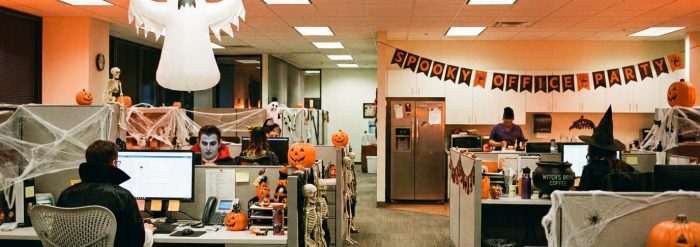
Decorations should be festive but safe and respectful. Pumpkins, fall colors, simple Halloween signs, candy bowls, paper decorations, and low-risk desk decorations are usually fine.
Employers should avoid decorations involving gore, hate symbols, religious mockery, sexual content, political attacks, violent imagery, or anything likely to frighten customers, patients, children, or vulnerable individuals. Healthcare, behavioral health, childcare, and customer-facing workplaces should be especially careful with frightening or graphic decorations.
Decorations should also be reviewed for safety. Do not block exits. Do not cover safety signs. Do not overload outlets. Do not run cords across walkways. Do not use open flames in office decorations. Do not place decorations where they interfere with work.
Alcohol at Halloween Parties
Alcohol is one of the fastest ways to turn a workplace event into an HR problem. If alcohol is served at a Halloween party, the employer should decide in advance who may drink, how much will be served, whether drink tickets will be used, whether transportation will be offered, whether supervisors should drink, and who will intervene if someone behaves inappropriately.
For many small employers, the simplest answer is to avoid alcohol entirely at workplace Halloween events. If the event is during work hours, alcohol should generally be avoided. If the event is after hours and offsite, the employer should still be careful because it may still be viewed as a company-sponsored event.
Alcohol does not excuse harassment, threats, fights, inappropriate comments, unsafe driving, or policy violations. If anything, alcohol increases the employer’s need to plan ahead.
Are Halloween Parties Paid Time?
If a Halloween event happens during regular work hours, non-exempt employees should generally be paid. If employees are expected or required to attend, or if not attending would negatively affect them, pay issues may arise.
The Department of Labor’s FLSA guidance explains that attendance at meetings, lectures, training programs, and similar activities does not have to be counted as hours worked only if four criteria are met: the event is outside normal hours, attendance is voluntary, the event is not job-related, and no other work is performed. The Texas Workforce Commission similarly explains that an employer does not have to pay for an outside-normal-hours meeting only if it is completely optional and non-work-related.
For Halloween, this means a truly optional after-hours party may not be compensable for non-exempt employees. But if attendance is required, expected, tied to morale scoring, used for work announcements, or held during scheduled work time, employers should be careful.
A practical rule: if you require non-exempt employees to be there, pay them.
Costume Contests and Prizes
Costume contests can be fun, but they should be structured carefully. Categories should be neutral and appropriate, such as “most creative,” “funniest work-appropriate costume,” “best team theme,” or “best fall theme.”
Avoid categories that focus on attractiveness, body type, sex appeal, ethnicity, religion, age, or stereotypes. Do not allow voting systems that encourage comments about employees’ bodies or protected characteristics.
If prizes are offered, apply the rules consistently. The contest should not reward costumes that violate the policy.
Photos and Social Media
Employers should be careful with photos. Some employees may not want to be photographed or posted on the company’s social media page. Others may participate in the event but not want their image used for marketing.
Before taking and posting photos, employers should tell employees that photos may be taken and give employees a reasonable way to opt out. For company social media, only authorized employees should post. Photos should be reviewed before posting to ensure costumes, decorations, backgrounds, badges, documents, patient information, client information, computer screens, and customer information are not exposed.
Employers should also remember that employees may have rights when discussing workplace issues online. The National Labor Relations Board explains that social media can be a form of protected concerted activity when employees discuss wages, benefits, or working conditions. That does not mean employees can post harassment or confidential information, but it does mean employers should be careful before disciplining social media posts about workplace events.
Can Employees Refuse to Participate?
Yes, in most cases employees should be allowed to opt out. If the event is just for fun, there is usually no good reason to force participation.
If the employer is hosting a customer-facing promotional event and costumes are part of the business operation, the employer should still consider religious, disability, safety, and professionalism issues. For example, a retail store may ask employees to wear a fall-themed shirt, but an employee with a religious objection to Halloween may need a reasonable alternative.
The employer should separate essential job duties from optional celebration.
What if a Customer Complains About an Employee’s Costume?
If a customer complains, the employer should review whether the costume violates the company’s policy, creates a safety concern, disrupts business, or affects customer service. If the costume is appropriate and the customer’s complaint is based on bias, the employer should not automatically punish the employee.
For example, if a customer objects to a religious head covering, cultural hairstyle, disability-related device, or gender expression, the employer should not treat the customer’s bias as a valid reason to remove the employee from the workplace. The EEOC’s religious discrimination guidance states that employers may not segregate employees based on religion, including religious garb or grooming practices, because of customer preference.
Halloween does not erase anti-discrimination obligations.
What if an Employee Complains About a Costume?
Take the complaint seriously. Do not dismiss it as “too sensitive” or “just Halloween.” Ask what the concern is, who was involved, what happened, whether others witnessed it, and whether the employee is requesting a specific response.
If the costume involves a protected characteristic, harassment, threats, religious concerns, or safety issues, the employer should investigate and respond appropriately. If the costume simply violates the company’s dress or safety rules, management can address it directly.
The response should be proportional. Some issues may require a quick correction, such as asking the employee to remove a mask or prop. More serious issues may require discipline, training, or a broader workplace message.
Supervisors Must Be Held to a Higher Standard
Managers and supervisors set the tone. If a supervisor wears an offensive costume, makes sexual comments, encourages alcohol misuse, mocks an employee’s religious objection, or pressures employees to participate, the employer’s risk increases.
Supervisors should be reminded before the event that they are still acting as representatives of the company. They should model appropriate conduct, enforce rules consistently, avoid questionable costumes, and report issues immediately.
A bad decision by a supervisor can turn a simple Halloween event into a company liability problem.
Halloween and Remote Employees
Remote employees should not be forgotten. If the company hosts a virtual costume contest or online Halloween event, the same rules apply. Costumes should be respectful. Participation should be voluntary. Screenshots and recordings should not be posted without permission. Chat comments should remain professional.
Remote events can still create harassment, discrimination, wage and hour, and social media issues. A virtual party is still a workplace event if the company sponsors it.
A Practical Halloween Policy Reminder for Employers
Employers do not need a long Halloween policy. A short seasonal reminder can work well.
The reminder should say that costumes are optional, must be workplace-appropriate, must not interfere with safety or job duties, and must not include discriminatory, harassing, sexually explicit, violent, threatening, or culturally offensive content. It should also state that normal workplace policies remain in effect, including anti-harassment, anti-discrimination, safety, confidentiality, social media, dress code, and alcohol policies.
The reminder should identify who employees can contact with questions or accommodation requests.
Sample Employer Message Before Halloween
Here is simple language employers can use:
“As Halloween approaches, employees may participate in approved workplace activities or wear costumes where permitted by their department. Participation is optional. Costumes must be safe, workplace-appropriate, and must not interfere with job duties, uniforms, PPE, customer service, patient care, food safety, or professional responsibilities. Costumes, decorations, jokes, or comments that are discriminatory, harassing, sexually explicit, threatening, culturally offensive, or otherwise inconsistent with company policy are not permitted. Employees who have religious, disability, safety, or other concerns should contact management before the event. All normal workplace policies remain in effect.”
That type of message prevents confusion without killing the fun.
Practical Checklist for Halloween at Work
Before Halloween, employers should ask:
- Is participation optional?
- Have costume expectations been communicated?
- Are safety rules clear for each department?
- Are decorations inspected for trip, fire, exit, and accessibility issues?
- Are religious objections handled respectfully?
- Are managers trained not to make inappropriate comments?
- Will alcohol be avoided or controlled?
- Will non-exempt employees be paid if attendance is required?
- Are photos and social media posts reviewed before posting?
- Is there a plan to respond if someone complains?
If the answer to any of these questions is unclear, the employer should tighten the plan before the event.
The Bottom Line for Texas Employers
Halloween can be good for morale, but it should not be unmanaged. Employers can allow costumes, parties, contests, decorations, and seasonal activities while still protecting the workplace.
The key is to communicate expectations early, make participation voluntary, prohibit harassment and discrimination, respect religious concerns, control safety risks, avoid alcohol-related problems, and make sure wage and hour rules are followed.
A good Halloween event should be fun, optional, safe, and professional. If employees remember the event for the wrong reason, the company missed the mark.
Contact the Texas HR Experts at The Unit Consulting
At The Unit Consulting, we help Texas employers create practical workplace policies that protect the business without eliminating employee morale. Seasonal events like Halloween may seem small, but they can expose gaps in harassment prevention, dress code rules, alcohol policies, safety practices, religious accommodation, wage and hour compliance, and manager training.
We can help your business review employee handbook language, create event guidelines, train managers, respond to employee complaints, and prevent small workplace issues from turning into bigger HR problems.
Your Texas HR services partners at The Unit Consulting helps Texas businesses keep workplace culture fun, compliant, and professional.